


52 items tagged "Spain"
Results 1 - 20 of 52
EWM Final Declaration - Girona Annual Meeting 2025
- Category: Press Releases
- Created on Monday, 22 December 2025 09:39

Girona, 8 December 2025
The EWM Annual Meeting 2025 came at a particularly critical moment, marked by deregulation processes promoted by the European Commission, growing pressure on water resources, and increasing frequency of prolonged droughts and floods. This context coincides with a key preparatory year for the third UN World Water Conference (December 2026), where Member States will need to define their positions and commitments.
This scenario is further complicated by the rise of far-right political forces across Europe, which drives deregulation and threatens fundamental rights such as universal access to water, recognized by the UN General Assembly and enshrined in the Drinking Water Directive.
In this context, the Girona meeting offered a platform for analyzing the impacts of European policies on water management and for developing strategies to defend water as a common and a fundamental human right. The event featured international, European, and national experts, providing critical and rigorous insights into current water-related challenges.
During the Girona meeting, held from 5 to 7 December, the European Water Movement (EWM), raised serious concerns regarding the negative consequences of the revision of the Water Framework Directive (WFD) announced by the European Commission on 10 December 2025, arguing it’s an obstacle for projects’ permitting such as mining projects. One of the main objectives of the meeting was to analyse the proposed deregulation of EU water-related legislation, both in terms of legislative amendment and financing mechanisms.
EWM Final Declaration - Girona Annual Meeting 2025
- Category: Press Releases
- Created on Monday, 22 December 2025 09:39
Girona, 8 December 2025
The EWM Annual Meeting 2025 came at a particularly critical moment, marked by deregulation processes promoted by the European Commission, growing pressure on water resources, and increasing frequency of prolonged droughts and floods. This context coincides with a key preparatory year for the third UN World Water Conference (December 2026), where Member States will need to define their positions and commitments.
This scenario is further complicated by the rise of far-right political forces across Europe, which drives deregulation and threatens fundamental rights such as universal access to water, recognized by the UN General Assembly and enshrined in the Drinking Water Directive.
In this context, the Girona meeting offered a platform for analyzing the impacts of European policies on water management and for developing strategies to defend water as a common and a fundamental human right. The event featured international, European, and national experts, providing critical and rigorous insights into current water-related challenges.
During the Girona meeting, held from 5 to 7 December, the European Water Movement (EWM), raised serious concerns regarding the negative consequences of the revision of the Water Framework Directive (WFD) announced by the European Commission on 10 December 2025, arguing it’s an obstacle for projects’ permitting such as mining projects. One of the main objectives of the meeting was to analyse the proposed deregulation of EU water-related legislation, both in terms of legislative amendment and financing mechanisms.
EWM Annual Event 2025 - Girona, Spain
- Category: Agenda
- Created on Wednesday, 15 October 2025 17:02
The European Water Movement meets in Girona to defend public management and the human right to water
From December 5 - 7, 2025, we will gather in Girona for the annual meeting of the European Water Movement (EWM).
We are an open, participatory, and diverse network that promotes water as part of the common heritage of humanity and as a fundamental human right essential for all living beings.
Over three days, activists, researchers, and representatives from public entities and social movements across Europe will discuss current challenges in water management, the advance of privatization, and the need to build public, democratic, and transparent models of water governance.
Not able to join in person ?
You can follow sessions online:
- Friday 5 December from 9am to 1pm
- Saturday 6 December from 11:30am to 1 pm
Join us on Zoom here https://us06web.zoom.us/j/85943306082
EWM Annual Event 2025 - Girona, Spain
- Category: Agenda
- Created on Wednesday, 15 October 2025 17:02
The European Water Movement meets in Girona to defend public management and the human right to water
From December 5 - 7, 2025, we will gather in Girona for the annual meeting of the European Water Movement (EWM).
We are an open, participatory, and diverse network that promotes water as part of the common heritage of humanity and as a fundamental human right essential for all living beings.
Over three days, activists, researchers, and representatives from public entities and social movements across Europe will discuss current challenges in water management, the advance of privatization, and the need to build public, democratic, and transparent models of water governance.
Not able to join in person ?
You can follow sessions online:
- Friday 5 December from 9am to 1pm
- Saturday 6 December from 11:30am to 1 pm
Join us on Zoom here https://us06web.zoom.us/j/85943306082
Cáceres' energy and lithium voracity against water, the law and people
- Category: Country & City Focus
- Created on Tuesday, 02 April 2024 15:20
Plataforma Salvemos la Montaña de Cáceres, 1 April 2024
Overview of the Cáceres lithium mine project

The lithium mine project at San José de Valdeflorez, less than 2 km from the town of Cáceres, which has a population of 100,000, is a perfect example of the perversion of a part of public institutions and politics that puts the short-term profit of mining and its tentacles into society before the security of the water supply, its recognition and its protection. It was revealed in the city in 2017, along with various errors in the administrative process by which the research permits were granted.
Cáceres' energy and lithium voracity against water, the law and people
- Category: Country & City Focus
- Created on Tuesday, 02 April 2024 15:20
Plataforma Salvemos la Montaña de Cáceres, 1 April 2024
Overview of the Cáceres lithium mine project
The lithium mine project at San José de Valdeflorez, less than 2 km from the town of Cáceres, which has a population of 100,000, is a perfect example of the perversion of a part of public institutions and politics that puts the short-term profit of mining and its tentacles into society before the security of the water supply, its recognition and its protection. It was revealed in the city in 2017, along with various errors in the administrative process by which the research permits were granted.
The Red Aqua Pública demands from the Ministry of Health that the process of transposition of the European directive on water for human consumption be participatory and transparent
- Category: Press Releases
- Created on Wednesday, 09 June 2021 16:26
Translation in English of the press release from Red Agua Pública
9 June 2021
On 16 December 2020, the Parliament and the Council of the European Union adopted the Directive 2020/2184 on the quality of water intended for human consumption. This legislation replaced the then existing legislation dating from 1998, which was clearly outdated. The revision of the directive was largely motivated by pressure from the Right2Water Citizens' Initiative "The right to water and sanitation as a human right", which was supported by nearly 2 million European citizens and many social organisations who argued that water supply cannot be governed by internal market rules, must be left out of the liberalisation process, and must meet strict conditions of information, public participation and accountability, all in the general context of the recognition of the human right to water.
Although the European Parliament took on board the demands of the Right2Water initiative, in the process of revising the 1998 directive, a significant part of the citizens' demands were relegated to the background, so that the directive approved in December 2020, although it represents an important step forward with respect to the previous one, does not cover the fundamental part of the citizens' demands expressed in the Right2Water initiative.
In accordance with the principle of subsidiarity as set out in Article 5 of the Treaty on European Union, the government has set in motion the process of transposing the new directive into Spanish law. This process, which is being led by the Ministry of Health, is being carried out in an opaque manner without encouraging citizen participation in an issue in which they should have a special presence, considering the defining principles of the human right to water.
In this context, the Red Aqua Pública has written to the Minister of Health -see attached letter-, denouncing this circumstance and offering its collaboration so that the transposition of the European directive includes the citizens' demands that were overlooked in the directive approved in December 2020. The letter has been sent to the heads of the Ministries of Consumer Affairs and Ecological Transition, as they are also directly involved in the process.

More information by :
Leandro del Moral 620666912
Pedro Pablo Serrano 649824397
Gonzalo Marín 646559647
The Red Aqua Pública (RAP) is a space that brings together dozens of platforms, social, environmental, trade union and political organisations in Spain that promote a vision of water as a commons and public service, and fight for the defence of public, non-profit, transparent and participatory management of water supply and sanitation services.
The Red Aqua Pública demands from the Ministry of Health that the process of transposition of the European directive on water for human consumption be participatory and transparent
- Category: Press Releases
- Created on Wednesday, 09 June 2021 16:26
Translation in English of the press release from Red Agua Pública
9 June 2021
On 16 December 2020, the Parliament and the Council of the European Union adopted the Directive 2020/2184 on the quality of water intended for human consumption. This legislation replaced the then existing legislation dating from 1998, which was clearly outdated. The revision of the directive was largely motivated by pressure from the Right2Water Citizens' Initiative "The right to water and sanitation as a human right", which was supported by nearly 2 million European citizens and many social organisations who argued that water supply cannot be governed by internal market rules, must be left out of the liberalisation process, and must meet strict conditions of information, public participation and accountability, all in the general context of the recognition of the human right to water.
Although the European Parliament took on board the demands of the Right2Water initiative, in the process of revising the 1998 directive, a significant part of the citizens' demands were relegated to the background, so that the directive approved in December 2020, although it represents an important step forward with respect to the previous one, does not cover the fundamental part of the citizens' demands expressed in the Right2Water initiative.
In accordance with the principle of subsidiarity as set out in Article 5 of the Treaty on European Union, the government has set in motion the process of transposing the new directive into Spanish law. This process, which is being led by the Ministry of Health, is being carried out in an opaque manner without encouraging citizen participation in an issue in which they should have a special presence, considering the defining principles of the human right to water.
In this context, the Red Aqua Pública has written to the Minister of Health -see attached letter-, denouncing this circumstance and offering its collaboration so that the transposition of the European directive includes the citizens' demands that were overlooked in the directive approved in December 2020. The letter has been sent to the heads of the Ministries of Consumer Affairs and Ecological Transition, as they are also directly involved in the process.
More information by :
Leandro del Moral 620666912
Pedro Pablo Serrano 649824397
Gonzalo Marín 646559647
The Red Aqua Pública (RAP) is a space that brings together dozens of platforms, social, environmental, trade union and political organisations in Spain that promote a vision of water as a commons and public service, and fight for the defence of public, non-profit, transparent and participatory management of water supply and sanitation services.
The retreat of the Llobregat delta
- Category: Country & City Focus
- Created on Monday, 03 May 2021 10:34
Translation into English of an article from the Taula del Llobregat
The Llobregat delta has retreated 800 metres in a century. A study by the Universitat Politècnica de Catalunya reveals that the width of the river at its mouth was 275 metres in 1846 and is currently 36 metres.
Scientists from the Universitat Politècnica de Catalunya reveal surprising data on the Llobregat river and its delta, in a study published in the journal Natural Hazards and Earth System Sciences. The most significant data is the quantification of the delta's retreat in just over 100 years. Using geolocated historical maps, they determined that the Llobregat delta, at its mouth, retreated 800 metres between 1891 and 2000, before the diversion of the mouth for the expansion of the Port of Barcelona.
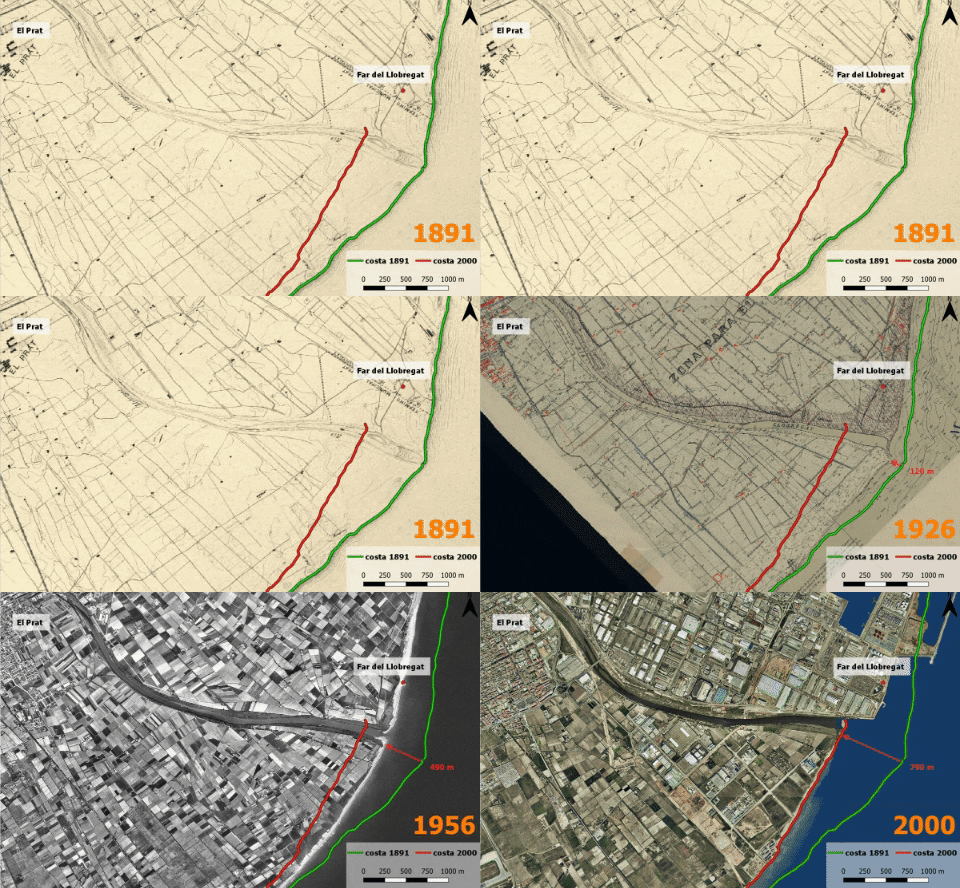
These data are relevant because it has never been calculated with this level of precision. "This retreat is very important. We knew that sand was being added to the Llobregat delta because it was retreating, but the extent of this retreat was unknown," explains Arnau Prats, a researcher at the UPC and one of the co-authors of the study.

The scientists started with a hypothesis that was not subsequently confirmed. "The hypothesis we put forward was that infrastructures, civil engineering works, the AVE railway, dams, but above all the motorway and the expressway, were responsible for this modification of the lower course of the Llobregat", explains Carles Ferrer, professor and researcher at the UPC and one of the three authors of the study.
Les universitaires ont eu une surprise : "La voie rapide et l'autoroute ont été construites il y a 50 ans et l'échelle de temps du recul du delta est de plus d'un siècle", souligne Juan P. Martín Vide, également enseignant et chercheur à l'UPC et troisième co-auteur de l'étude. Il fallait donc chercher les causes ailleurs.
The Llobregat lock dams and the erosive action of the sea, main causes of the delta's retreat
The authors of the study consider that the reservoir dams of La Baells, La Llosa del Caballo and Santo Ponç are not the main cause of the delta's retreat because they are located several kilometres from the mouth and "the transport of sediment is slow", according to researcher Arnau Prats. He explains that "the transport of coarse sediments from the bottom of the river can take decades to arrive from Baells to the mouth".
The three authors of the study -Juan P. Martín Vide, Carles Ferrer and Arnau Prats- point to the lock dams as the main cause of the delta's retreat. They were built throughout the 19th century with the aim of exploiting hydraulic energy. These infrastructures, as well as the different channels in the last river section, have reduced the contribution of coarse sediments to Prat de Llobregat, which are the ones that make the delta move forward. In addition, the action of the waves has eroded the land that the river had gained on the sea.
On the other hand, the researchers found that when there is a flood at the headwaters of the river, the marshes reduce the supply of sediment because they reduce the water flow by 20%. And this reduction has an effect on the transport of sand and gravel. "We have found that the reservoir dams cause, on average, a 20% reduction in the peak flow of the Llobregat at the river mouth, and that this 20% reduction leads to a 40% reduction in the transport of sediments from the river. Nevertheless, the impact of this inertia is still limited in the delta. According to Professor Juan P. Martin Vide, the effect "will be more important in a few decades".

Eliminating channelling to reverse the trend
Scientists do not foresee miracle solutions but a change in the trend. "We can't talk about solutions like in other areas of life or engineering, where everything is solved once the remedy is known and applied. Here, we should rather think of changes in trends", explains Juan P. Martín Vide.
They believe that the measures that can be taken will take a long time to become visible. "We have to keep in mind that these lock dams are located several kilometres upstream from the delta. Therefore, any action taken now would take a long time to be noticed," adds Carles Ferrer. He suggests: "In addition to the lock dams, we could also think about the small streams, tributaries, etc. that are channelled through concrete dikes, which also limit the sediment supply to the delta and are closer to the mouth. We could think about removing these channels which, in the long term, could help to increase the sediment supply from the Llobregat to the delta.
The removal of these channels and lock dams is the long-term solution proposed by the study, while the traditional provision of sand on the beaches of the delta is a short-term and ephemeral measure.
The new river mouth, a sediment trap
The Llobregat is one of the rivers that have been intensively exploited since the industrial revolution in Catalonia.
From its source in Castellar de n'Hug to its mouth in Prat de Llobregat, there are 170 kilometres of reservoir dams at La Baells, La Llosa del Caballo and Santo Ponç, as well as numerous lock dams and channels.

In 2004, the diversion of the mouth 2 km further south than the original mouth was inaugurated, due to the expansion of the port of Barcelona. However, the infrastructure did not foresee what would happen to the sediment. "The new mouth is twice as wide as the old one. And this poses a problem for the transport of sediment from the river to the beach. During floods, when there is more sediment transport, the riverbed is wider and the water velocity is therefore lower. As a result, the material transported by the river is trapped at the bottom and reaches the coast less. And this fact is not without consequences: "What happens is that this bottom increases because of the accumulation of sand that comes from upstream and is not deposited on the coast. And this, in the long term, can be a problem because the hydraulic capacity of this channel can decrease due to the rise in the bottom," concludes researcher Arnau Prats.
The "hardest working" river
Since the beginning of the 19th century, the Llobregat River has been equipped with lock dams and channels to supply the textile factories born of the industrial revolution. So much so that the French geographer Pierre Deffontaines (1894-1978) said: "Perhaps no river in the world has been so intensively exploited as the indigent Llobregat".
Sources :
https://beteve.cat/medi-ambient/retroces-delta-riu-llobregat/
https://www.sostenible.cat/reportatge/el-preu-de-la-revolucio-industrial-al-llobregat
The retreat of the Llobregat delta
- Category: Country & City Focus
- Created on Monday, 03 May 2021 10:34
Translation into English of an article from the Taula del Llobregat
The Llobregat delta has retreated 800 metres in a century. A study by the Universitat Politècnica de Catalunya reveals that the width of the river at its mouth was 275 metres in 1846 and is currently 36 metres.
Scientists from the Universitat Politècnica de Catalunya reveal surprising data on the Llobregat river and its delta, in a study published in the journal Natural Hazards and Earth System Sciences. The most significant data is the quantification of the delta's retreat in just over 100 years. Using geolocated historical maps, they determined that the Llobregat delta, at its mouth, retreated 800 metres between 1891 and 2000, before the diversion of the mouth for the expansion of the Port of Barcelona.
These data are relevant because it has never been calculated with this level of precision. "This retreat is very important. We knew that sand was being added to the Llobregat delta because it was retreating, but the extent of this retreat was unknown," explains Arnau Prats, a researcher at the UPC and one of the co-authors of the study.
The scientists started with a hypothesis that was not subsequently confirmed. "The hypothesis we put forward was that infrastructures, civil engineering works, the AVE railway, dams, but above all the motorway and the expressway, were responsible for this modification of the lower course of the Llobregat", explains Carles Ferrer, professor and researcher at the UPC and one of the three authors of the study.
Les universitaires ont eu une surprise : "La voie rapide et l'autoroute ont été construites il y a 50 ans et l'échelle de temps du recul du delta est de plus d'un siècle", souligne Juan P. Martín Vide, également enseignant et chercheur à l'UPC et troisième co-auteur de l'étude. Il fallait donc chercher les causes ailleurs.
The Llobregat lock dams and the erosive action of the sea, main causes of the delta's retreat
The authors of the study consider that the reservoir dams of La Baells, La Llosa del Caballo and Santo Ponç are not the main cause of the delta's retreat because they are located several kilometres from the mouth and "the transport of sediment is slow", according to researcher Arnau Prats. He explains that "the transport of coarse sediments from the bottom of the river can take decades to arrive from Baells to the mouth".
The three authors of the study -Juan P. Martín Vide, Carles Ferrer and Arnau Prats- point to the lock dams as the main cause of the delta's retreat. They were built throughout the 19th century with the aim of exploiting hydraulic energy. These infrastructures, as well as the different channels in the last river section, have reduced the contribution of coarse sediments to Prat de Llobregat, which are the ones that make the delta move forward. In addition, the action of the waves has eroded the land that the river had gained on the sea.
On the other hand, the researchers found that when there is a flood at the headwaters of the river, the marshes reduce the supply of sediment because they reduce the water flow by 20%. And this reduction has an effect on the transport of sand and gravel. "We have found that the reservoir dams cause, on average, a 20% reduction in the peak flow of the Llobregat at the river mouth, and that this 20% reduction leads to a 40% reduction in the transport of sediments from the river. Nevertheless, the impact of this inertia is still limited in the delta. According to Professor Juan P. Martin Vide, the effect "will be more important in a few decades".
Eliminating channelling to reverse the trend
Scientists do not foresee miracle solutions but a change in the trend. "We can't talk about solutions like in other areas of life or engineering, where everything is solved once the remedy is known and applied. Here, we should rather think of changes in trends", explains Juan P. Martín Vide.
They believe that the measures that can be taken will take a long time to become visible. "We have to keep in mind that these lock dams are located several kilometres upstream from the delta. Therefore, any action taken now would take a long time to be noticed," adds Carles Ferrer. He suggests: "In addition to the lock dams, we could also think about the small streams, tributaries, etc. that are channelled through concrete dikes, which also limit the sediment supply to the delta and are closer to the mouth. We could think about removing these channels which, in the long term, could help to increase the sediment supply from the Llobregat to the delta.
The removal of these channels and lock dams is the long-term solution proposed by the study, while the traditional provision of sand on the beaches of the delta is a short-term and ephemeral measure.
The new river mouth, a sediment trap
The Llobregat is one of the rivers that have been intensively exploited since the industrial revolution in Catalonia.
From its source in Castellar de n'Hug to its mouth in Prat de Llobregat, there are 170 kilometres of reservoir dams at La Baells, La Llosa del Caballo and Santo Ponç, as well as numerous lock dams and channels.
In 2004, the diversion of the mouth 2 km further south than the original mouth was inaugurated, due to the expansion of the port of Barcelona. However, the infrastructure did not foresee what would happen to the sediment. "The new mouth is twice as wide as the old one. And this poses a problem for the transport of sediment from the river to the beach. During floods, when there is more sediment transport, the riverbed is wider and the water velocity is therefore lower. As a result, the material transported by the river is trapped at the bottom and reaches the coast less. And this fact is not without consequences: "What happens is that this bottom increases because of the accumulation of sand that comes from upstream and is not deposited on the coast. And this, in the long term, can be a problem because the hydraulic capacity of this channel can decrease due to the rise in the bottom," concludes researcher Arnau Prats.
The "hardest working" river
Since the beginning of the 19th century, the Llobregat River has been equipped with lock dams and channels to supply the textile factories born of the industrial revolution. So much so that the French geographer Pierre Deffontaines (1894-1978) said: "Perhaps no river in the world has been so intensively exploited as the indigent Llobregat".
Sources :
https://beteve.cat/medi-ambient/retroces-delta-riu-llobregat/
https://www.sostenible.cat/reportatge/el-preu-de-la-revolucio-industrial-al-llobregat
Manure pollution from the Osona and Lluçanès springs in 2020
- Category: Country & City Focus
- Created on Wednesday, 06 May 2020 19:21
The Grup de Defensa del Ter has been analysing the nitrate concentration in springs located in the counties of Osona and Lluçanès for 19 years and this year the historical record for nitrate concentration was broken in one of these springs. The analysis was made possible thanks to 53 volunteers from the Grup de Defensa del Ter who visited 164 springs, 13 of which were not flowing. The average nitrate concentration was 72 mg/l, while the WHO has set the limit for the drinking water purification at a nitrate concentration of 50 mg/l. The average value this year is slightly lower than in 2019, which was 76 mg/l, although the difference is not significant enough to assume that there has been a real decrease in pollution. We still have almost half of the contaminated springs, about 45%.
The Gana spring in Calldetenes with 492.2 mg/l of nitrates was the most polluted this year, beating the historical record since the beginning of the analyses in 2002, followed by two springs usually on the podium, the Gallisans spring in Santa Cecília de Voltregà, with 465.8 mg/l, and in third place, the Cassanell spring in Taradell, with 344.80 mg/l. Last year, the first prize was awarded to the latter source, with 456.8 mg/l. This year, however, the Gana spring is at nearly 500 mg/l of nitrate, a value 10 times higher than what the WHO allows for the drinking water purification. This is undoubtedly the highest value we have found in 19 years of source analysis.

Read more in Catalan on the website of the Grup de Defensa del Ter
Manure pollution from the Osona and Lluçanès springs in 2020
- Category: Country & City Focus
- Created on Wednesday, 06 May 2020 19:21
The Grup de Defensa del Ter has been analysing the nitrate concentration in springs located in the counties of Osona and Lluçanès for 19 years and this year the historical record for nitrate concentration was broken in one of these springs. The analysis was made possible thanks to 53 volunteers from the Grup de Defensa del Ter who visited 164 springs, 13 of which were not flowing. The average nitrate concentration was 72 mg/l, while the WHO has set the limit for the drinking water purification at a nitrate concentration of 50 mg/l. The average value this year is slightly lower than in 2019, which was 76 mg/l, although the difference is not significant enough to assume that there has been a real decrease in pollution. We still have almost half of the contaminated springs, about 45%.
The Gana spring in Calldetenes with 492.2 mg/l of nitrates was the most polluted this year, beating the historical record since the beginning of the analyses in 2002, followed by two springs usually on the podium, the Gallisans spring in Santa Cecília de Voltregà, with 465.8 mg/l, and in third place, the Cassanell spring in Taradell, with 344.80 mg/l. Last year, the first prize was awarded to the latter source, with 456.8 mg/l. This year, however, the Gana spring is at nearly 500 mg/l of nitrate, a value 10 times higher than what the WHO allows for the drinking water purification. This is undoubtedly the highest value we have found in 19 years of source analysis.
Read more in Catalan on the website of the Grup de Defensa del Ter
Red Agua Pública on World Water Day : Facing climate change, assuming the climate emergency
- Category: Press Releases
- Created on Sunday, 22 March 2020 02:43
The Red Agua Pública (RAP) claims the need to assume the climate emergency and the determination to advance in the fight against climate change. The RAP reaffirms the demand to implement public, democratic, transparent and sustainable management models for the integral urban water cycle.
Every year, on 22 March, at the initiative of the United Nations, World Water Day is commemorated with the aim of drawing attention to problem of water through relevant issues. In 2020, the World Water Day has been focused on the relationship between climate change and water, and the impacts and the policies for adapting to climate change affect and are related to water directly.
There is a broad social and scientific consensus that the impacts of climate change on water resources will lead to substantial changes in the availability, quality and quantity of water for aquatic ecosystems and basic human needs. It can threat the effective enjoyment of the human rights to water and sanitation. Food sovereignty, human health, urban and rural settlements, energy production, industrial and economic development, employment and ecosystems are all dependent on water and therefore vulnerable to the impacts of climate change.
Red Agua Pública on World Water Day : Facing climate change, assuming the climate emergency
- Category: Press Releases
- Created on Sunday, 22 March 2020 02:43
The Red Agua Pública (RAP) claims the need to assume the climate emergency and the determination to advance in the fight against climate change. The RAP reaffirms the demand to implement public, democratic, transparent and sustainable management models for the integral urban water cycle.
Every year, on 22 March, at the initiative of the United Nations, World Water Day is commemorated with the aim of drawing attention to problem of water through relevant issues. In 2020, the World Water Day has been focused on the relationship between climate change and water, and the impacts and the policies for adapting to climate change affect and are related to water directly.
There is a broad social and scientific consensus that the impacts of climate change on water resources will lead to substantial changes in the availability, quality and quantity of water for aquatic ecosystems and basic human needs. It can threat the effective enjoyment of the human rights to water and sanitation. Food sovereignty, human health, urban and rural settlements, energy production, industrial and economic development, employment and ecosystems are all dependent on water and therefore vulnerable to the impacts of climate change.
Metropolitan Area of Barcelona: Agreement for a public and democratic water system
- Category: Country & City Focus
- Created on Thursday, 14 March 2019 13:12
Barcelona´s city growth obliged it to expand beyond its own walls and expand onto the Eixample district. Since then, the management of water resources has mainly been in private hands and has grown in this way throughout the majority of towns and cities of the larger Metropolitan Area. Despite this fact, in 2010 a Barcelona court ruled that there was no public contracting situation to regulate this management. Two years on in 2012 the government of Àrea Metropolitana de Barcelona (AMB) created a mixed company as partners with Sociedad General de Agua de Barcelona (AGBAR group) to manage the urban water cycle of supply and sanitation.
In 2016, the mixed partnership was cancelled by the Supreme Court of Catalonia (TSJC) due to various irregularities: there had been no reasoning as to why the mixed partnership was the better option, besides the contract was ´passed on´ -conceded without public tender- the private part of the mixed venture, and finally, the valuation of assets was tipped very obviously in AGBAR’s favor. The court ruling by the TSJC will be considered in the next months by the Supreme Court of Spain, which is under the obligation of reaching a final verdict. If this verdict rules against the mixed company, this would make a perfect opportunity to make the water system public again for the communities of AMB.
Metropolitan Area of Barcelona: Agreement for a public and democratic water system
- Category: Country & City Focus
- Created on Thursday, 14 March 2019 13:12
Barcelona´s city growth obliged it to expand beyond its own walls and expand onto the Eixample district. Since then, the management of water resources has mainly been in private hands and has grown in this way throughout the majority of towns and cities of the larger Metropolitan Area. Despite this fact, in 2010 a Barcelona court ruled that there was no public contracting situation to regulate this management. Two years on in 2012 the government of Àrea Metropolitana de Barcelona (AMB) created a mixed company as partners with Sociedad General de Agua de Barcelona (AGBAR group) to manage the urban water cycle of supply and sanitation.
In 2016, the mixed partnership was cancelled by the Supreme Court of Catalonia (TSJC) due to various irregularities: there had been no reasoning as to why the mixed partnership was the better option, besides the contract was ´passed on´ -conceded without public tender- the private part of the mixed venture, and finally, the valuation of assets was tipped very obviously in AGBAR’s favor. The court ruling by the TSJC will be considered in the next months by the Supreme Court of Spain, which is under the obligation of reaching a final verdict. If this verdict rules against the mixed company, this would make a perfect opportunity to make the water system public again for the communities of AMB.
Spain fined €12 million for failing to treat urban waste water
- Category: News from the Ground
- Created on Thursday, 26 July 2018 11:29
26 July 2018
Nearly 18 years after deadline expired, nine municipalities still lack proper collection or treatment systems.
The European Court of Justice on Wednesday ordered Spain to pay a €12 million fine for prolonged failure to comply with a European directive on urban waste water collection and treatment.
In an earlier judgment issued in 2011, this court had found that there were still 43 agglomerations with a population of 15,000 or more that failed to meet EU standards, even though member states were supposed to have adequate collection and treatment systems in place since 2001.
Spain was given a 2013 deadline to comply, but the deadline expired and 17 localities were still discharging their waste water without proper treatment.
In 2017, the EU Commission brought new action, and the Court of Justice has now fined Spain a lump sum of €12 million, plus a penalty payment of €11 million for every six-month period of delay in getting the remaining municipalities up to speed on their water treatment standards.
As of today, there are nine Spanish municipalities that still fail to meet EU urban waste water regulations: seven in Andalusia (Matalascañas, Alhaurín el Grande, Isla Cristina, Tarifa, Coín, Nerja and Barbate), one in Asturias (Gijón Este) and one in the Canary Islands (Valle de Güímar).
Read more on website of El País
Spain fined €12 million for failing to treat urban waste water
- Category: News from the Ground
- Created on Thursday, 26 July 2018 11:29
26 July 2018
Nearly 18 years after deadline expired, nine municipalities still lack proper collection or treatment systems.
The European Court of Justice on Wednesday ordered Spain to pay a €12 million fine for prolonged failure to comply with a European directive on urban waste water collection and treatment.
In an earlier judgment issued in 2011, this court had found that there were still 43 agglomerations with a population of 15,000 or more that failed to meet EU standards, even though member states were supposed to have adequate collection and treatment systems in place since 2001.
Spain was given a 2013 deadline to comply, but the deadline expired and 17 localities were still discharging their waste water without proper treatment.
In 2017, the EU Commission brought new action, and the Court of Justice has now fined Spain a lump sum of €12 million, plus a penalty payment of €11 million for every six-month period of delay in getting the remaining municipalities up to speed on their water treatment standards.
As of today, there are nine Spanish municipalities that still fail to meet EU urban waste water regulations: seven in Andalusia (Matalascañas, Alhaurín el Grande, Isla Cristina, Tarifa, Coín, Nerja and Barbate), one in Asturias (Gijón Este) and one in the Canary Islands (Valle de Güímar).
Read more on website of El País
Social agreement for water in defense of our rivers and for public water
- Category: News from the Ground
- Created on Saturday, 07 July 2018 11:46
March, 22, 2018
A wide range of (Spanish) civil society organizations and entities agree that we are facing a really decisive moment to recover and maintain the good state of conservation of our aquatic ecosystems, not only to comply with the Water Framework Directive and other commitments. Europeans in this area, but to adapt to the reality imposed by climate change, reduce our vulnerability to the growing risks of drought and floods and ensure sustainable use of water, with demands adapted to the resources actually available. On the other hand, we face privatization pressures, both in terms of the commodification of water rights and the privatization of water and sanitation services and even irrigation management.
The unsustainable growth of water demands, both in irrigation and urban-industrial uses, is currently one of the main problems to achieve a sustainable use of water and the good ecological status of our ecosystems.
Social agreement for water in defense of our rivers and for public water
- Category: News from the Ground
- Created on Saturday, 07 July 2018 11:46
March, 22, 2018
A wide range of (Spanish) civil society organizations and entities agree that we are facing a really decisive moment to recover and maintain the good state of conservation of our aquatic ecosystems, not only to comply with the Water Framework Directive and other commitments. Europeans in this area, but to adapt to the reality imposed by climate change, reduce our vulnerability to the growing risks of drought and floods and ensure sustainable use of water, with demands adapted to the resources actually available. On the other hand, we face privatization pressures, both in terms of the commodification of water rights and the privatization of water and sanitation services and even irrigation management.
The unsustainable growth of water demands, both in irrigation and urban-industrial uses, is currently one of the main problems to achieve a sustainable use of water and the good ecological status of our ecosystems.
